
What We Measure
You think you have data—but you don't have decision visibility.
Your existing avionics don't work anymore. You're flying in fog with instruments built for a world that moved at human speed, where authority was centralized, and where intuition could compensate. That world ended in 2024.
Now? You're outnumbered by machines that aren't even smart. Authority is scattered across systems you can't see. And the correction window keeps collapsing faster than meetings or dashboards can keep up.
But how do you govern what you can’t see?
We map what you can't see—remotely, continuously, in real time.
Stealth Dog measures decision behavior as infrastructure using only publicly available data. No surveys. No interviews. Nothing invasive. We track how decisions are actually formed, escalated, and executed under real conditions—before they scale into irreversible outcomes.
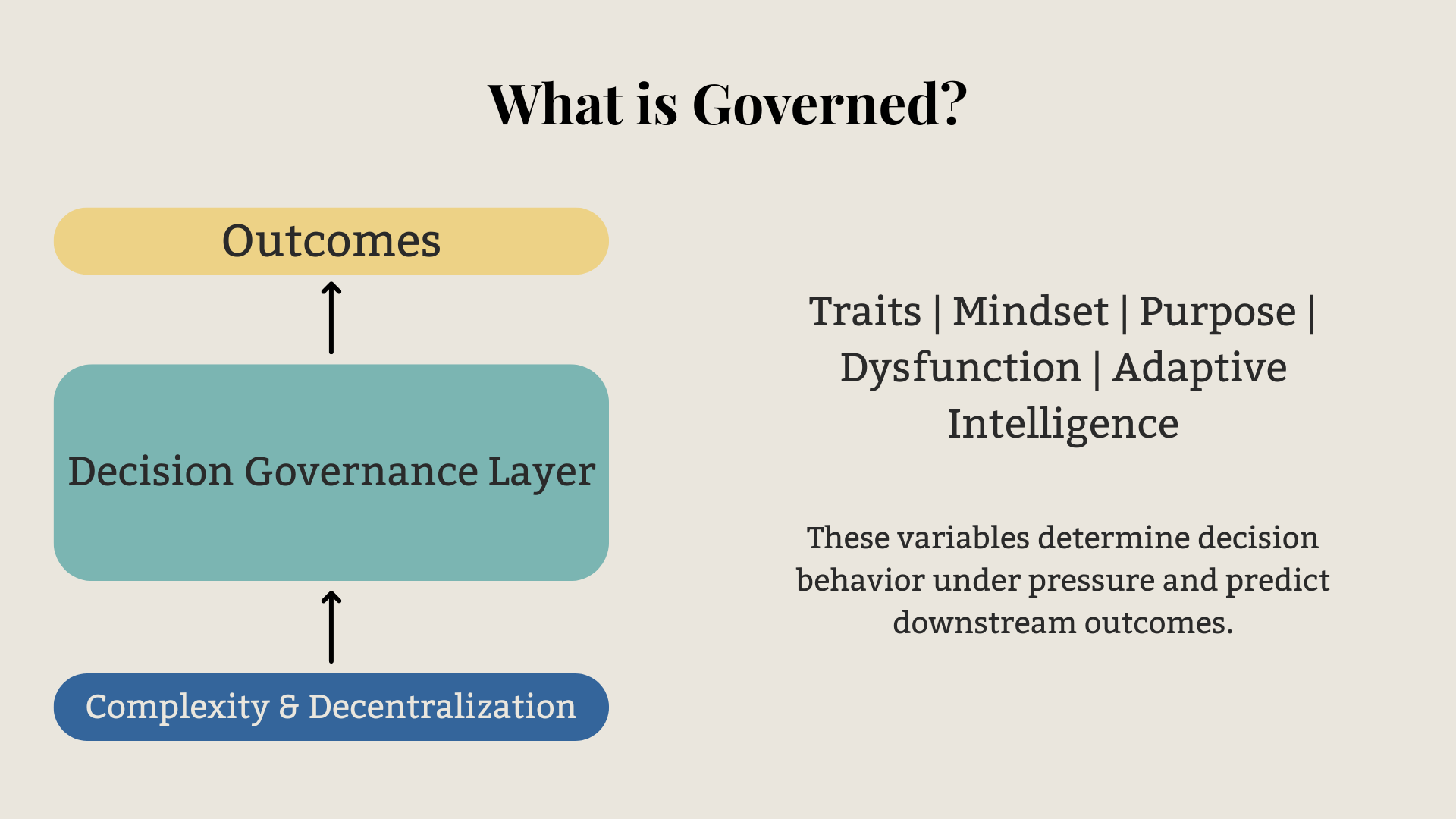
We measure four dimensions of decision capacity across people, teams, and machines:
Decision Traits
How individuals and systems execute under pressure, e.g., consistency, risk tolerance, follow-through, response to uncertainty.
Decision Mindset & Purpose
What tradeoffs are consistently optimized for. Whether decisions prioritize short-term certainty, long-term value, control, speed, or adaptability.
Decision Dysfunction
Where fear, ego, misalignment, or incentive distortion suppress signal. Dysfunction isn't a cultural label—it's measurable interference in judgment and escalation.
Adaptive Intelligence
The capacity to operate effectively as complexity increases. How well decision-makers and systems learn, recalibrate, and respond as conditions change.
This is decision infrastructure, not analytics.
These signals reveal significance and causality months before they appear in financial, operational, or compliance metrics. That early visibility lets you govern AI before it accelerates misalignment—by constraining what decisions automation can make, whose judgment it inherits, and where human oversight must remain.
When decision behavior is measurable, it becomes governable.
The top 6% don't work harder. They protect decision signal faster than noise accumulates. They maintain visibility on traits and adaptive capacity as infrastructure—not as HR concepts, but as governance variables. And they preserve effective hierarchy so smart people stay in charge of smart people, even as teams scale and complexity multiplies. In short, they have decision visibility, and you could too.